
Monday brief
Nine things you didn’t know about marmots
Marmots are large, ground-dwelling members of the squirrel family and are among the most recognizable animals found in the Alps and other mountain regions. With their round bodies, fluffy fur, and adorable appearance, they have become beloved symbols of alpine landscapes.
Michael Turner
Desk note
Brief tip
The full sticky-note brief continues below on the Monday desk.
Board
Desk Notes
Marmots are large, ground-dwelling members of the squirrel family and are among the most recognizable animals found in the Alps and other mountain regions. With their round bodies, fluffy fur, and adorable appearance, they have become beloved symbols of alpine landscapes.
Although many people recognize these charming mountain rodents, marmots have a surprisingly interesting history, social structure, and set of survival adaptations.
There Are Fourteen Living Species of Marmots
Today, there are fourteen known living species of marmots, along with four additional species that have been identified from fossil evidence.
The alpine marmot (Marmota marmota) is the only marmot species found in the European Alps. Other marmot species live in mountain regions of North America, including the hoary marmot (Marmota caligata) and the yellow-bellied marmot (Marmota flaviventris).
Not every marmot lives at high elevations. The groundhog (Marmota monax) is a marmot species that prefers lower-elevation habitats rather than mountainous environments.
Alpine Marmots Have Their Own Alarm Language
Marmots are famous for their loud, sharp whistles, which they use to warn others of danger.
Alpine marmots have different alarm calls depending on the type of threat they detect. A single high-pitched whistle usually signals danger from above, such as a hunting eagle. Multiple whistles often indicate a threat approaching from the ground.
Research on some North American marmot species has not shown the same clear connection between specific alarm sounds and different types of predators.
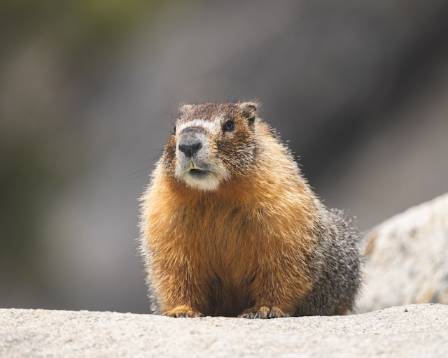
Marmots Live in Family Groups and Form Strong Bonds
Marmots are social animals that usually live in family units with a clear hierarchy. Each family is led by a dominant male and female, and normally only this breeding pair produces offspring each year.
The dominant female helps control reproduction within the group and prevents other members from mating.
Each family has its own underground burrow system. Over many generations, these tunnels can expand into large and complex networks. During winter, all members of the family gather together in the main sleeping chamber, known as the hibernaculum, where they spend the cold months.
Some Marmots Mate Outside the Family Pair
Although marmots are generally considered monogamous, genetic research has revealed that their social system is not always as strict as it appears.
Studies have found that between about 2.2% and 13% of young marmots may have a father other than the dominant male. In some cases, babies within the same litter can even have different fathers.
Marmot Families Live Together in Colonies
Multiple marmot families often form larger colonies. Within these colonies, each family maintains its own territory.
Neighboring groups usually avoid close interaction, and encounters between different families can sometimes become aggressive.
Marmots mark the boundaries of their territory using scent signals from their droppings. These scent markings help identify which areas belong to each family group.
Marmots Spend Most of Their Lives Sleeping
Marmots are famous for their long hibernation periods. They may spend around 200 days each year in a dormant state, losing approximately one-third of their body weight during this time.
Instead of eating throughout winter, they survive by using stored body fat. Their sleep is not completely continuous, however. They experience short periods of activity, which scientists believe may help maintain proper body temperature.
Young marmots face a major challenge during their first year. They must eat enough food during their early months to build sufficient energy reserves before their first winter hibernation.
Whistler Mountain Got Its Name From Marmots
In Canada, marmots are often called “whistlepigs” or “whistlers” because of their loud warning calls.
The famous Canadian ski destination Whistler received its name because of the many marmots living in the area and their distinctive whistles. The mountain was originally known as London Mountain, but as tourism developed, a more appealing name was chosen to attract visitors.
Marmots First Appeared in North America
Marmots have an ancient evolutionary history. After the continents of North America and Eurasia separated around 40 million years ago, rodent populations on the two continents developed independently.
The earliest marmots appeared in North America approximately 15 million years ago. Later, around one million years ago, some marmot populations crossed the Bering Strait into Eurasia, eventually giving rise to the marmot species found there today.
Marmots May Have Helped Humans Find Gold
Marmots have even played a role in ancient stories about gold discovery.
Around 2,500 years ago, the Greek historian Herodotus described large “golden ants” that were said to be larger than foxes and connected with gold collection in the ancient Persian Empire.
For centuries, this story was considered fictional. However, research in the 1990s suggested that Herodotus may actually have been describing golden marmots living in what is now Pakistan.
The ancient Persian word for marmot translated roughly as “mountain ant.” These marmots dug burrows in sandy soils containing gold particles, and small amounts of gold-bearing material became attached to their fur. Historians now believe local people may have collected gold from the sand brought to the surface by these burrowing animals.

More from this board
NOTE · en

Roses: Timeless Beauty
Few flowers are as admired and cherished as the rose. With its soft petals, delightful fragrance, and timeless appeal, the rose has long been associated with affection, elegance, and romance. Available in a wide range of colors, forms, and varieties, roses add beauty to gardens, homes, and special events around the world. Whether displaying rich red blooms, gentle pink shades, or cheerful yellow blossoms, roses have a unique ability to brighten any environment and create a sense of sophistication.
NOTE · en

Top 5 Most Beautiful Coasts in the World
Coastal landscapes often showcase some of nature’s most impressive creations. Vast ocean views, the rhythm of crashing waves, and scenery ranging from tropical shores to rugged cliffs make coastlines unforgettable destinations. Among the countless beautiful coastal areas across the globe, some stand out as true masterpieces of natural beauty. Here are five spectacular coastlines that deserve a place on any traveler’s list.
NOTE · en

The 5 Most Enchanting Flowers on Earth
Flowers possess a unique power to stir joy and evoke emotions, dominating our artistic expressions, literature, and cultural traditions. Their vivid colors, varied forms, and captivating fragrances create an immediate sense of connection and appreciation.
NOTE · en

Sumptuous Dessert Inspirations Using Coconut Milk
Canned coconut milk is a pantry essential for anyone seeking to elevate their dessert game. Its naturally high fat content and velvety consistency make it a superior alternative to traditional dairy, providing a lush mouthfeel and a subtle tropical aroma. Whether used as a base for dairy-free frozen treats, stirred into slow-cooked grains, or whisked into elegant custards and cakes, coconut milk transforms simple ingredients into indulgent masterpieces. Keeping a few cans on hand ensures that a sophisticated and satisfying sweet treat is always within reach.
NOTE · en

A Comprehensive Guide to Selecting Authentic Vietnamese Traditional Attire
Choosing a piece of Vietnamese traditional clothing—whether the globally recognized Áo Dài or a regional specialty like the Áo Bà Ba—is an exercise in appreciating history, textile art, and cultural etiquette. These garments are designed to balance grace with modesty, and finding the right one requires attention to fabric quality, structural fit, and the specific occasion for which it is intended. For international visitors, selecting a garment that respects local traditions while providing a flattering silhouette involves a few key considerations regarding material and construction.
NOTE · en

The Best 7 Storage Furniture Pieces
Anyone living in a relatively compact home knows how much smart storage can improve everyday life. When storage is planned well, it makes everything easier to find and gives every item a logical place. When it is poorly designed—or missing altogether—it can quickly become a daily source of annoyance.