Monday brief
Lady Amherst Pheasant: A Striking Ornamental Bird
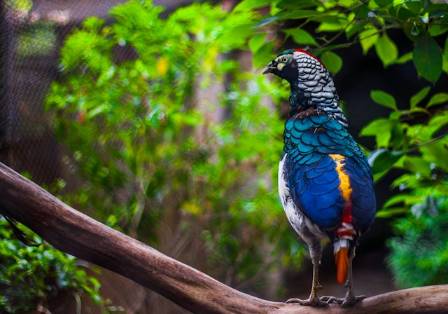
Many pheasant species are popular among ornamental bird enthusiasts because of their remarkable and colorful plumage. Every variety has its own distinctive appearance, making pheasants especially appealing to people who enjoy keeping beautiful birds. Among the most artistically patterned species is the Lady Amherst pheasant.
Aria Sterling
Desk note
Brief tip
The full sticky-note brief continues below on the Monday desk.
Board
Desk Notes
Many pheasant species are popular among ornamental bird enthusiasts because of their remarkable and colorful plumage. Every variety has its own distinctive appearance, making pheasants especially appealing to people who enjoy keeping beautiful birds. Among the most artistically patterned species is the Lady Amherst pheasant.
Scientifically known as Chrysolophus amherstiae, the Lady Amherst pheasant is native to southwestern China and Tibet. The species has also established a population in the United Kingdom, although its numbers there are currently declining.
Based on scientific classification, the Lady Amherst pheasant is closely related to Chrysolophus pictus, commonly called the golden pheasant. Like many other pheasants, Lady Amherst pheasants generally prefer running along the ground rather than flying. They do, however, regularly climb into trees to roost at night.
The Lady Amherst pheasant belongs to the order Galliformes and the family Phasianidae. Its genus name comes from the Ancient Greek khrusolophos, meaning “with the golden coat of arms.” The English common name and the species name amherstiae honor Sarah Countess Amherst, the wife of William Pitt Amherst, Governor General of Bengal. He was responsible for sending the first specimen of the bird to London in 1828.
The species is naturally distributed across southwestern China and Burma. Over time, however, Lady Amherst pheasants were introduced into other regions. Lady Amherst herself first brought the ornamental bird to her estate near the Duke of Bedford’s Woburn Abbey, where the species was subsequently bred in England in an effort to expand its population.
Physical Appearance
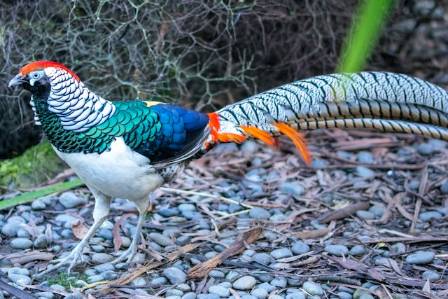
The Lady Amherst pheasant measures approximately 100–120 cm in total length, with the tail alone usually reaching around 80 cm. Its rump can display red, blue, green, white, or yellow coloring, while the tail is generally gray. The species also has yellow eyes and blue or gray-colored feet.
There is a dramatic difference between males and females. Males possess spectacularly colorful plumage, whereas females have a much simpler and less conspicuous appearance.
The male Lady Amherst pheasant has an especially distinctive crest and neck feathers. The feathers at the back of his head extend downward along the rear of the neck, creating an appearance that resembles long hair flowing down a woman’s back when viewed from a distance.
In the wild, the behavior of Lady Amherst pheasants is broadly similar to that of other pheasant species. Males do not normally assist females with nest construction and are not known for forming particularly faithful partnerships. When kept in captivity, females may sometimes fail to incubate their own eggs, in which case domestic chickens may be used to hatch them.
Interesting Characteristics of the Lady Amherst Pheasant
There are many fascinating characteristics associated with the Lady Amherst pheasant, but its appearance and natural lifestyle are among the features that attract the most attention.
1. Physical Characteristics of Lady Amherst Pheasant
Lady Amherst pheasants are exceptionally eye-catching birds. Their elaborate appearance makes them seem almost like living works of art, and their unusual plumage is one of the main reasons they are valued as ornamental birds.
Their feathers feature striking patterns of contrasting stripes that can resemble delicate brushstrokes. The overall coloration combines shades of green, red, white, black, metallic dark blue, and orange. These vivid colors, together with the long feathers extending from the tail, create a highly distinctive natural appearance.
2. Population Distribution of Lady Amherst Pheasant
The Lady Amherst pheasant originally comes from southwestern China and Tibet and extends into northern Burma. Humans have also introduced the species to various other parts of the world.
Populations or introduced birds have been recorded in places including the United Kingdom, Hawaii, and New Zealand.
Lady Amherst pheasants have also been observed in the United States. However, these birds are generally believed to have escaped from aviaries or been intentionally released rather than forming naturally established breeding populations in the country.
3. Lady Amherst Pheasant Behavior and Lifestyle
Although male Lady Amherst pheasants are extremely conspicuous because of their elaborate appearance, relatively little has been documented about their detailed behavior and lifestyle in the wild.
What is known is that these pheasants spend their days searching for food on the ground. At night, they commonly move into trees to roost.
Although they possess wings and are capable of flight, Lady Amherst pheasants generally favor running across the ground. When suddenly startled or threatened, however, they can rapidly take to the air and fly away at considerable speed.
4. Lady Amherst Pheasant Food
Lady Amherst pheasants are omnivorous and consume both animal and plant foods. Their animal-based diet can include spiders and small beetles.
For plant material, they feed on ferns and particularly enjoy bamboo shoots. They also eat seeds, tubers, and strawberries, giving them a varied diet that changes according to the food available in their surroundings.
5. Reproduction and Life Cycle of Lady Amherst Pheasant
The breeding season begins with males establishing their territories around the middle of March. Females generally begin laying eggs around the middle of April.
The female constructs her nest directly on the ground. These nests are commonly positioned beneath bushes or among piles of twigs and usually consist of shallow, roughly circular depressions lined or surrounded by dry leaves.
During a single breeding period, a Lady Amherst pheasant can produce between 6 and 12 cream-colored eggs. The incubation period lasts approximately 24 days.
Once the chicks hatch, they leave the nest almost immediately and begin following their mother to feeding areas, where they learn to locate food. Young Lady Amherst pheasants have coats displaying graduated shades of golden brown, light brown, and yellowish white.
6. Lady Amherst Pheasant Lifetime
In the wild, Lady Amherst pheasants generally face environmental changes, predators, and other natural threats. Under these conditions, they may live for approximately 6–10 years.
Individuals kept in captivity can have considerably longer lifespans. Captive Lady Amherst pheasants have been recorded living for more than 15 years.
7. Interesting Facts About Lady Amherst Pheasant
The Lady Amherst pheasant was introduced from its native China to England in relatively small numbers, with much of the population becoming associated with Bedfordshire. The breeding population there is estimated to consist of no more than 10 pairs.
Another fascinating feature of the species is its elaborate courtship display. During its ritualized dance, the male shows off his spectacular feathers, highlighting the vivid colors and intricate patterns of his plumage.
Despite being capable of flight, Lady Amherst pheasants usually respond to danger by running away rather than immediately taking flight. They generally fly only when they are startled or when they need to reach a tree branch where they can roost.
Conclusion
The Lady Amherst pheasant is an exceptionally elegant and distinctive member of the pheasant family. Its brilliant colors, elaborate feathers, and unusual appearance have made it a popular ornamental bird and an attractive choice for people who enjoy keeping beautiful birds.
Its striking appearance and fascinating behavior make the Lady Amherst pheasant an especially interesting species to learn about. From its colorful plumage and courtship displays to its ground-based lifestyle and unusual nesting habits, this pheasant has many characteristics that set it apart.
More from this board
NOTE · en

Top 5 Beachfront Villa
With countless breathtaking destinations across the globe, deciding where to spend your next vacation can be a difficult choice. For travelers searching for privacy, comfort, and unforgettable ocean views, beachfront villas offer an exceptional way to experience luxury.
NOTE · en
The Most Colorful Fields: Top 5 Flower Realms to See in the World
Summer opens a door to living canvases: vast fields painted with petals of every hue. From Europe’s lilting valleys to Dubai’s dazzling desert, flower fields invite wanderers to pause, breathe, and immerse themselves in color. Here are five of the world’s most breathtaking blooms, where rainbow landscapes become unforgettable memories.
NOTE · en
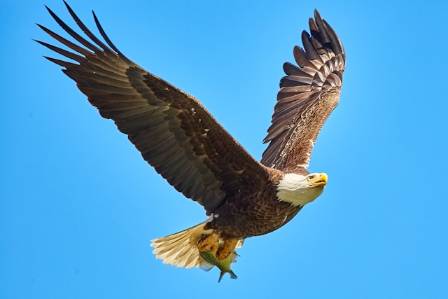
The Bald Eagle: An Emblem of North American Skies
The Bald Eagle (Haliaeetus leucocephalus) is the national symbol of the United States and one of the most recognizable birds of prey in North America. Known for its dark chocolate-brown body contrasted against a stark white head and tail, this raptor is a member of the Accipitridae family. It belongs to a specialized group of ten species known as "sea eagles" or "fish eagles," which are distinguished by their featherless lower legs and feet, an adaptation suited for their aquatic hunting habits.
NOTE · en

Horseshoe Bend:All Essential Information for Your Upcoming Visit to This Natural Geographic Wonder
Dreaming of exploring the stunning Horseshoe Bend inside Glen Canyon National Recreation Area? This comprehensive handbook covers all travel essentials and countless enjoyable activities waiting for you!
NOTE · en

How to Dress Like an Outdoorsman
Fashion trends may change constantly, but the rugged outdoorsman aesthetic has remained a classic choice for men. Its lasting popularity comes from its balance of practicality, strength, and understated masculinity. It does not rely on flashy designs or attention-grabbing details. Instead, it reflects authenticity, adventure, craftsmanship, and a connection to a hardworking lifestyle.
NOTE · en
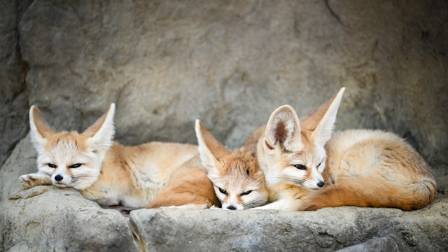
Meet the Animal Park's Fennec Foxes
Fennec foxes are small desert-dwelling animals that are native to the sandy regions of North Africa. With their oversized ears and remarkable adaptations, they are perfectly suited to surviving in some of the harshest environments on Earth.